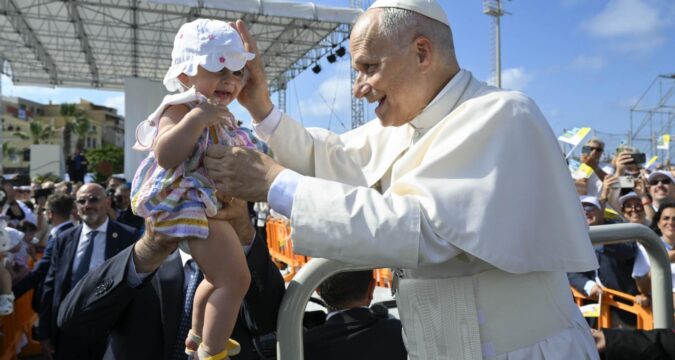
LAMPEDUSA (CNS): When Pope Leo XIV marked the 250th anniversary of the United States’ Declaration of Independence on July 4, he did so on Lampedusa, Italy, a European migrant entry point, praying for migrants buried in the island’s cemetery, meeting survivors and celebrating Mass where tens of thousands of people flee war, persecution and poverty.
Pope Leo laid flowers at the graves of migrants who died attempting to cross the Mediterranean. He met a migrant family at the “Door of Europe” monument, blessed a plaque naming Favaloro Pier after Pope Francis, and later celebrated Mass beneath an image of Our Lady of Safe Harbour.
The visit deliberately echoed Pope Francis’s first journey outside Rome in 2013, when he came to Lampedusa to denounce what he called the “globalisation of indifference.”
In his remarks marking the United States’ 250th birthday, the first American pope praised the nation’s founding ideals of liberty and religious freedom, while reminding Americans that immigrants “have formed part of the history of this country from its very beginning.”
He said, “Defending human life also includes welcoming, protecting, and assisting immigrants,” describing such welcome as “not only an act of charity, but also a recognition of the dignity that belongs to every human person.”
Defending human life also includes welcoming, protecting, and assisting immigrants
Pope Leo XIV
Migration has been a priority, as a matter of human dignity, for Pope Leo, who pointed out that immigrants “have formed part of the history of this country [the US] from its very beginning.”
He said, “To receive them with compassion and generosity is not only an act of charity, but also a recognition of the dignity that belongs to every human person.”
Pope Leo said the 250th anniversary of the signing of the Declaration of Independence is not only an invitation to celebrate, “but also to reflect upon the responsibilities that the sons and daughters of this country bear to one another.”
In his homily at the Arena sports field in the Salina district of Lampedusa, the pope said, “I am grateful to the Lord for the opportunity to visit you, following in the footsteps of Pope Francis.”
While reiterating his predecessor’s focus on migrants, Pope Leo gave the message his own theological emphasis.
Reflecting on the parable of the Good Samaritan, he said Lampedusa today lies “along a path as perilous as the one that led down from Jerusalem to Jericho.”
Those who have lost their lives in this sea are victims both of decisions that were made and of decisions that were not made
Pope Leo
He noted, “Those who have lost their lives in this sea are victims both of decisions that were made and of decisions that were not made.”
The pope praised the fishermen, volunteers, rescue workers, civil authorities, and ordinary island residents who have welcomed migrants for years, thanking them for demonstrating “the miracle of compassion.”
He said, “There is no love of God without love of neighbour, and there is no neighbour if I do not draw near.”
Pope Leo pointed out that “indifference to the common good and corruption in migrants’ countries” generates poverty and exclusion. Quoting his first encyclical, Magnifica Humanitas, he said, “no one is without responsibility.”
The pope also urged Europe to move beyond emergency responses, calling for long-term policies capable of “receiving, protecting, supporting, and integrating migrants,” while helping developing countries so that “no one is forced to emigrate.”
There is no love of God without love of neighbour, and there is no neighbour if I do not draw near
Pope Leo
The visit echoed the pope’s June apostolic journey to Spain, when he devoted some of his strongest remarks on migration to the Canary Islands, another major gateway for migrants seeking to reach Europe. Speaking there, he urged Europeans not to allow tourism to obscure the human suffering unfolding along migration routes and challenged visitors to “have the courage to think differently,” saying authentic rest should lead people to rediscover the meaning of life and solidarity with others.
Pope Leo repeated that theme in Lampedusa, again invoking the image of the Good Samaritan to argue that Christian discipleship requires drawing near to those in need rather than “passing by.”
“Have the courage to think differently,” the pope urged.
“All of this must be done with vigilance, ensuring respect for the dignity of every person,” the pope said on July 4. “This is a task not only for public institutions but also for civil society as a whole and for the Church.”
Filippo Mannino, the mayor of Lampedusa, told the pope that the island is a beacon that “does not judge” and “does not choose whom to illuminate,” but remains lit through the night for anyone searching for shore.
“No one is too small to point the way,” he said.